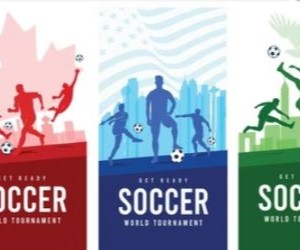

Discover which playing styles will dominate the 2026 World Cup, with tactical analysis, statistics, and football trivia for fans.
WHAT IS THE DESIGN OF THE OFFICIAL BALL FOR THE 2026 WORLD CUP?
The 2026 World Cup is shaping up to be epic: three host countries (USA, Mexico, and Canada), 48 teams, multiple stadiums… and, of course, a ball designed to capture that magnitude. We're talking about the Trionda, the official match ball designed by Adidas for the tournament. In this article, we break down its design—colors, symbols, structure—what it represents, and what statistics and interesting facts surround this collector's item. If you're passionate about soccer, you'll love learning about every detail that will be rolling on the pitch in 2026.


History and context of the ball
The 2026 World Cup will be unique: for the first time, three countries will host a tournament of this magnitude—the United States, Mexico, and Canada. This context shapes the design of the official ball: the Adidas Trionda. Named for the fusion of "tri" (for the three countries) and "onda" (for shared energy), Trionda represents movement, unity, and shared passion. It was unveiled on October 2, 2025, at a joint event between Adidas and FIFA, generating significant buzz on social media and in sports media.
A symbol of continental collaboration
The choice of this name and concept reflects the vision of unity and cooperation among the host countries. Every visual element of the ball tells a story, and this story begins with the idea of three football cultures coming together for a global tournament.
First World Cup with 48 teams.
Venues spread across three culturally diverse countries.
Official presentation at FIFA headquarters in Zurich.
Name with strong symbolic meaning: Trionda.
Design conceived as a visual emblem of the event.
From its inception, the ball was designed not only as a tool for the game, but as a visual representation of the spirit of the World Cup. 2026.

Colors, Symbols, and Details
The design of the Adidas Trionda leaves nothing to chance. Its white base serves as a canvas for an explosion of dynamic graphics that blend red, green, and blue, representing Canada, Mexico, and the United States, respectively. Each color is used not only for aesthetics but also as a national and cultural symbol.
Iconography and Visual Elements
Over each colored segment appear icons representing each country: Canada's red maple leaf, stylized Aztec figures and a green eagle for Mexico, and blue stars alluding to the American flag. These elements are not simply printed; They are part of a flowing composition that simulates movement, reflecting the dynamism of football.
Fluid graphics that evoke "the wave" in stadiums.
Golden strokes that symbolize the World Cup.
Rough texture with micro-patterns for improved grip.
Heat-sealed finish for moisture resistance.
Aerodynamic design optimized with artificial intelligence.
Visually, the ball is designed to stand out both on the pitch and in HD and 4K broadcasts. The patterns were tested to ensure they appeared sharp from various distances and camera angles.

Technology and Technical Evolution
The Adidas Trionda is more than just beautiful: it's a technological marvel. It incorporates "connected ball" technology, which includes an internal sensor to transmit real-time data used by VAR and other analysis tools. Furthermore, it's composed of only four heat-sealed panels, improving flight accuracy and reducing the impact of seams on ball control.
The Science Behind the Ball
Every ball undergoes pressure, weather, bounce, and rotation tests to ensure its performance in extreme conditions. The Trionda is no exception. It was developed in the Adidas laboratory in Herzogenaurach, Germany, with the assistance of artificial intelligence and feedback from professional players. 4 heat-sealed panels for improved aerodynamics. Internal IMU sensor for real-time data. Regulation weight and size with minimal tolerance. Micro-textured coating for greater precision. Designed with feedback from goalkeepers and forwards. This ball represents the continuous evolution of the beautiful game. It not only connects the players on the pitch, but also millions of fans through data and instant replays that enrich the World Cup experience.
YOU MAY ALSO BE INTERESTED